During infrastructure changes, a user wanted to verify whether a public-facing device had left remote administration more exposed than intended.
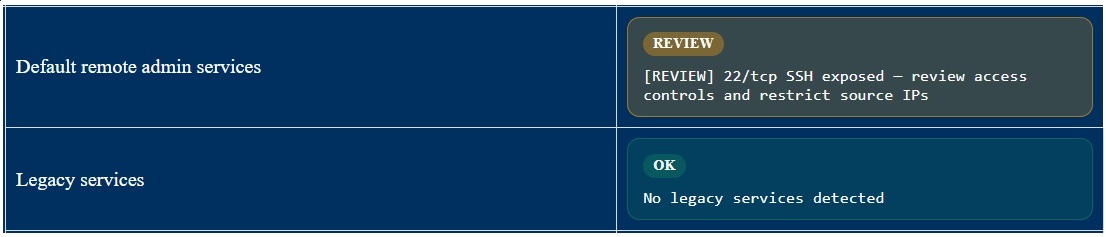
Front Screen was used to review the target from the internet-facing side. The check highlighted SSH-related risk and returned practical recommendations focused on reducing exposure and tightening administrative access.
What the check identified
The review showed that SSH deserved attention as an externally reachable management surface. In addition, the target had reputation signals associated with SSH-related attack activity, which increased the need for careful hardening.
Example result from the check

Why this matters
SSH is a legitimate administration protocol, but once it is reachable from the public internet it often becomes a target for automated scanning, password guessing, and repeated login attempts. Even when public exposure is intentional, access should be tightly limited and carefully controlled.
In this example, the public target is masked as 2*.9*.5*.9* in the case study rather than being shown in full.
Additional result example
Recommended follow-up actions
- Confirm whether SSH needs to be reachable from the public internet at all.
- Disable password-based authentication and use key-based access only.
- Restrict source IPs to a very small set of trusted administrative addresses.
- Apply rate limiting or brute-force protection.
- Keep SSH software and configuration up to date.
In this case, the scan gave a clear signal that remote administration should be reviewed and reduced to tightly controlled, legitimate access only.